
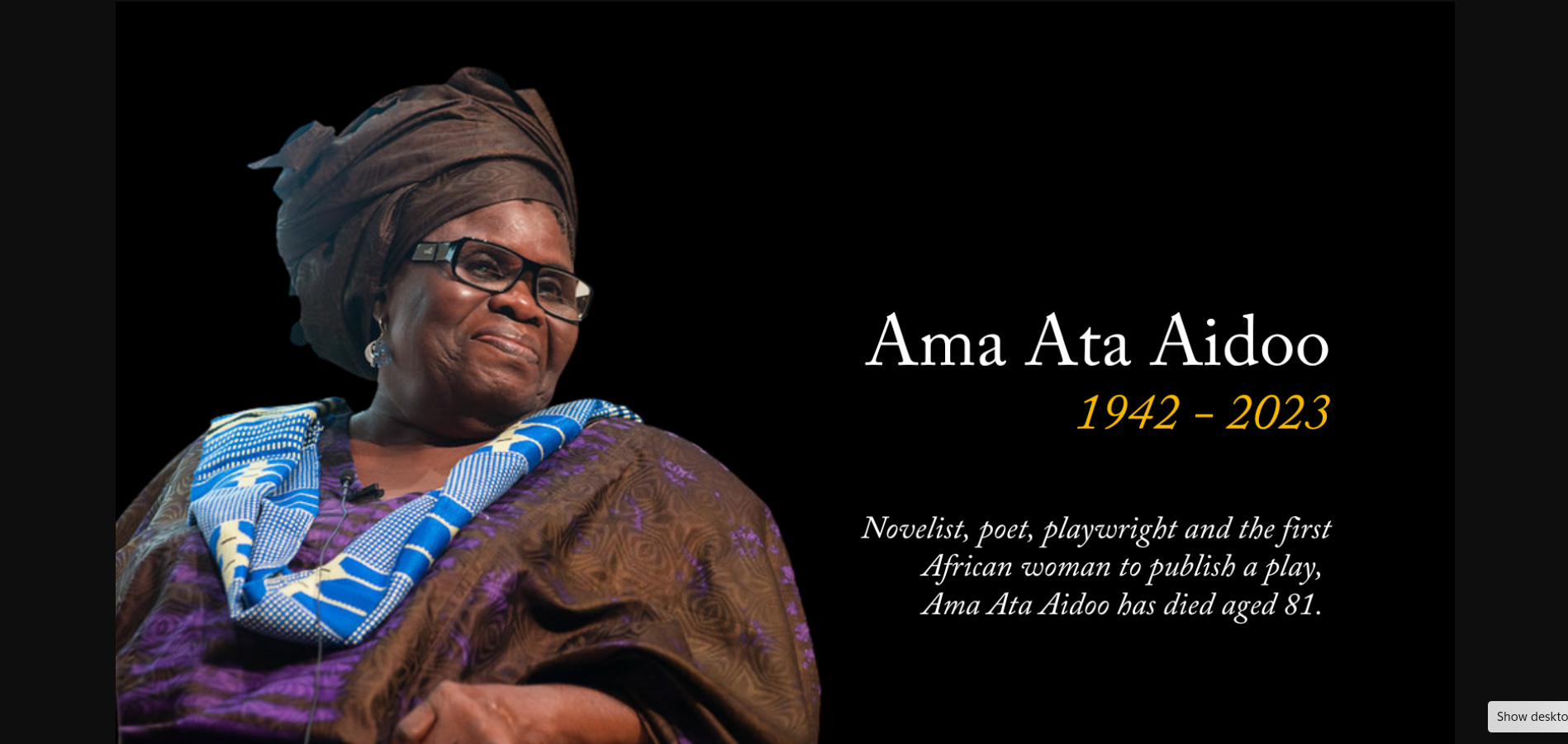
Ama Ata Aidoo: Life, Major Works, Themes and Legacy
Ama Ata Aidoo (1942–2023) was one of Ghana’s most important writers and one of the pioneering voices of African women’s literature. A novelist, playwright, poet, essayist, academic, and public intellectual, Aidoo used literature to question colonialism, patriarchy, nationalism, cultural change, and the limited ways in which African women were represented in literature.
Her writing is particularly important because she did not present African women simply as victims of tradition or colonialism. Instead, her female characters are often intelligent, complicated, outspoken, contradictory, and capable of making choices within difficult social circumstances.
Through works such as The Dilemma of a Ghost, Anowa, Our Sister Killjoy, No Sweetness Here, and Changes: A Love Story, Aidoo developed a distinctive literary voice that brought together African traditions, oral forms, modern literary techniques, feminism, and postcolonial criticism.
Her influence also extended beyond her own writing. Through teaching, public service, and the establishment of the Mbaasem Foundation, Aidoo worked actively to create opportunities for African women writers.
Who Was Ama Ata Aidoo?
Ama Ata Aidoo was born Christina Ama Ata Aidoo on 23 March 1942 in Abeadzi Kyiakor in Ghana’s Central Region, then the Gold Coast. She grew up in a Fante royal household. Her father, Nana Yaw Fama, was a chief of Abeadzi Kyiakor and an advocate of education who established a school in the village.
Her upbringing exposed her to both African cultural traditions and Western education. This combination became important to her later writing. Much of Aidoo’s work explores what happens when African societies encounter colonial and Western ideas, and she repeatedly questions the assumption that modernity necessarily means abandoning African traditions.
Aidoo attended Wesley Girls’ Senior High School in Cape Coast before entering the University of Ghana, Legon, in 1961 to study English. While at the university, she became involved in literary and theatrical activities and wrote her first play, The Dilemma of a Ghost. The play was published in 1965 and established Aidoo as the first published African woman dramatist.
Her literary career developed alongside an academic career. She taught at universities in Ghana, Africa, and the United States and became an important figure in African literary and intellectual circles.
Ama Ata Aidoo and African Literature
Aidoo emerged during an important period in African literary history. The decades around African independence saw the growth of African literature in English and other European languages, with writers such as Chinua Achebe, Wole Soyinka and Ngũgĩ wa Thiong’o challenging colonial representations of Africa.
Yet the early African literary canon was heavily dominated by men.
Aidoo entered this literary environment and asked a question that remained central to much of her writing:
Where are African women in the stories being told about Africa?
Her response was not simply to add women to existing narratives. She challenged the assumptions behind those narratives.
Her women characters experience marriage, motherhood, sexuality, economic pressures, migration, education, political change and cultural expectations. They can be loving and angry, traditional and rebellious, vulnerable and powerful.
The result is a body of literature that complicates simple divisions between “African tradition” and “Western modernity.”
Aidoo’s work has consequently become central to discussions of African feminism, postcolonial literature, gender, nationalism and African women’s writing. The African Studies Association’s Women’s Caucus describes her as a feminist and anti-colonialist whose writing advocated for African women and drew deeply on African tradition and orature.
Major Works by Ama Ata Aidoo
Aidoo wrote across several literary forms, including drama, fiction, poetry, short stories, essays and children’s literature.
Some of her best-known works include:
The Dilemma of a Ghost (1965)
The Dilemma of a Ghost was Aidoo’s first major literary work and remains one of the most important plays in African literature.
The play centres on Ato, a Ghanaian man who returns home after studying in the United States, and Eulalie, his African-American wife. Their marriage brings together different understandings of Africa, America, family, marriage and cultural identity.
The play examines the difficulties that emerge when individual aspirations meet family and communal expectations.
It also introduces several concerns that would remain important throughout Aidoo’s career: the relationship between Africa and its diaspora, cultural conflict, gender expectations, and the tension between individual freedom and social responsibility.
Anowa (1970)
Anowa is another major play and one of Aidoo’s most frequently studied works.
Set in nineteenth-century Ghana, the play follows Anowa, a young woman who refuses to accept the conventional expectations placed upon women.
Her decision to choose her own husband and determine the direction of her life brings her into conflict with her family and society.
The play explores marriage, gender, wealth, slavery, African traditions and individual freedom.
Anowa is particularly significant because Aidoo does not construct her simply as a victim. She is a woman who makes choices, questions social expectations and insists on her own agency.
Our Sister Killjoy; or, Reflections from a Black-Eyed Squint (1977)
Our Sister Killjoy is Aidoo’s first novel and one of her most innovative works.
The novel follows Sissie, a young Ghanaian woman who travels to Europe. Her experiences abroad allow Aidoo to examine colonialism and the psychological consequences of colonial education and cultural hierarchy.
Sissie’s encounter with Europe does not produce the uncomplicated sense of admiration that colonial education might have encouraged.
Instead, Europe becomes a space from which she can critically examine both European society and the African societies from which she comes.
The novel is notable for its experimental form. Aidoo combines prose, poetry, letters, dialogue and interior reflection.
Through Sissie, Aidoo also explores the African diaspora and the relationship between Africa and the West.
No Sweetness Here (1970)
No Sweetness Here is a collection of short stories that examines everyday life in Ghana.
Rather than presenting “African culture” as something fixed and unchanging, Aidoo portrays communities undergoing social, economic and cultural transformation.
Her stories explore marriage, family, education, gender relations, class and the tensions between older and newer ways of life.
The collection includes the well-known stories “No Sweetness Here” and “Two Sisters.”
The stories demonstrate one of Aidoo’s strengths: she could use ordinary domestic situations to reveal much larger questions about society.
Changes: A Love Story (1991)
Changes: A Love Story is perhaps Aidoo’s best-known novel.
The central character, Esi Sekyi, is an educated Ghanaian professional woman who makes decisions about marriage and relationships that challenge conventional expectations.
The novel explores love, marriage, sexuality, motherhood, work, economic independence and women’s agency.
Esi’s experiences also expose contradictions within contemporary Ghanaian society. Education and professional success give women new possibilities, but social expectations surrounding marriage and femininity remain powerful.
The novel won the Commonwealth Writers’ Prize for Best Book in the Africa region in 1992.
Someone Talking to Sometime (1985)
Aidoo was also an accomplished poet.
Her poetry engages questions of memory, identity, history, gender, Africa and the African diaspora.
Her collection Someone Talking to Sometime received the Nelson Mandela Prize for Poetry in 1987.
Her poetry demonstrates that Aidoo’s interest in African identity and history was not limited to fiction and drama. Poetry gave her another form through which to explore personal experience alongside wider political and historical questions.
Major Themes in Ama Ata Aidoo’s Writing
1. African Women and Feminism
Gender is perhaps the most recognisable concern in Aidoo’s writing.
But Aidoo’s representation of women is more complicated than simply presenting women as oppressed by men.
Her women negotiate institutions such as marriage, family, education, work and sexuality. They make choices within systems that can restrict them, and those choices sometimes produce unexpected consequences.
Characters such as Anowa, Sissie and Esi are therefore important because they challenge passive representations of African women.
Aidoo’s work helped establish African women’s writing as a major field of literary and intellectual inquiry. Scholars have noted the way her novels disrupted stereotypical representations of women in male-authored African literature.
2. Tradition and Modernity
Aidoo frequently questions the idea that African tradition and Western modernity are simple opposites.
Her characters live in societies where different cultural systems overlap.
Education, Christianity, Western ideas about marriage, African customs, economic change and colonial history all shape the choices people make.
Rather than simply celebrating either “tradition” or “modernity,” Aidoo asks what happens to individuals when these systems come into conflict.
3. Colonialism and Its Afterlives
Colonialism is another major concern in Aidoo’s work.
For her, colonialism did not end simply because African countries became politically independent.
Its influence continued through education, cultural attitudes, economic relationships and ideas about what constitutes progress.
This concern is particularly visible in Our Sister Killjoy, where Sissie’s experiences in Europe allow the novel to examine the psychological and cultural consequences of colonialism.
Aidoo understood literature as part of the broader struggle to recover African agency after colonialism.
4. Africa and the Diaspora
The relationship between Africa and Africans outside the continent is another recurring concern.
This is particularly evident in The Dilemma of a Ghost and Our Sister Killjoy.
Aidoo does not treat the African diaspora simply as a community that exists outside Africa. Instead, she explores the complex historical, emotional and political relationship between Africa and its descendants.
This makes questions of migration, belonging, identity and cultural memory central to her work.
5. Marriage and Women’s Choices
Marriage appears repeatedly in Aidoo’s fiction and drama.
But marriage in her work is not simply a private romantic institution.
It is connected to:
- family expectations
- economic security
- sexuality
- motherhood
- social status
- gender roles
- women’s independence
In Changes, for example, Esi’s attempt to create a life that accommodates both professional independence and intimate relationships reveals the tensions experienced by educated Ghanaian women.
6. Education
Education occupies an important place in Aidoo’s writing and public life.
She understood education as potentially liberating, but she was also aware that colonial education could reproduce Western assumptions about Africa.
Her own life reflected this tension. She received a Western-style education while remaining deeply connected to African cultural traditions.
She also became politically involved in education. In 1982, Aidoo was appointed Ghana’s Minister of Education, becoming the first woman to hold that position. She resigned after about eighteen months when she concluded that the government’s direction could not accommodate her vision for accessible education.
Ama Ata Aidoo and African Feminism
Aidoo occupies an important position in the development of African feminist literary thought.
One reason her work remains significant is that she did not simply import European feminist ideas into African settings.
Her writing begins from the experiences of African women themselves.
Questions about marriage, motherhood, work, sexuality, family and cultural expectations are therefore examined within particular African social and historical contexts.
This is one reason Aidoo’s work continues to feature prominently in discussions about African feminism and the representation of women in African literature.
Her contribution is also intellectual rather than merely representational. Through essays, interviews, teaching and public commentary, Aidoo participated directly in debates about how African women should be represented and how African literature itself should be understood.
Her 1981 essay “Unwelcome Pals and Decorative Slaves, or Glimpses of Women as Writers and Characters in Contemporary African Literature” is one example of her intervention in debates about women’s place within African literary production.
Ama Ata Aidoo and Oral Tradition
Although Aidoo was a writer of printed literature, oral tradition remained important to her literary imagination.
Her work draws on African storytelling practices, proverbial language, communal forms of narration and dramatic performance.
This is particularly visible in Anowa, where the use of the Old Man and Old Woman as commenting figures recalls the communal and performative dimensions of African storytelling.
Her writing therefore demonstrates that African modern literature does not have to abandon oral traditions in order to be modern.
Instead, oral forms can become part of modern literary experimentation.
This connection between orality and writing is one reason Aidoo’s work is important to the study of African literature as a whole.
Ama Ata Aidoo as a Public Intellectual
Aidoo’s contribution went beyond her published books.
In 1982 she became Ghana’s Minister of Education under the Provisional National Defence Council government headed by Jerry Rawlings. She was the first woman to hold the position. She later left Ghana and worked in Zimbabwe before continuing her academic and literary career elsewhere.
She also established the Mbaasem Foundation, an organisation dedicated to supporting African women writers and their artistic work.
Mbaasem’s stated mission was to support the development and sustainability of African women writers and to create an environment in which women could write, tell and publish their stories. Its activities included writing workshops, writers’ forums, literary events, residencies and support for emerging writers.
This part of Aidoo’s legacy is especially important because she did not only argue for greater visibility for African women writers. She helped create structures through which that visibility could be achieved.
Awards and Recognition
Throughout her career, Aidoo received significant recognition for her literary and intellectual contributions.
Among these were:
- Mbari Club Prize, 1962, for her short story “No Sweetness Here”
- Nelson Mandela Prize for Poetry, 1987, for Someone Talking to Sometime
- Commonwealth Writers’ Prize for Best Book, Africa, 1992, for Changes: A Love Story
- Honorary Doctor of Letters (DLitt), University of Ghana, 2013
She was also the subject of substantial scholarly attention during her lifetime, including Essays in Honour of Ama Ata Aidoo at 70: A Reader in African Cultural Studies, demonstrating the extent to which her writing had become part of African literary scholarship.
Ama Ata Aidoo’s Legacy
Ama Ata Aidoo died in Accra on 31 May 2023, aged 81. Her death marked the loss of one of Ghana’s most influential literary figures.
But Aidoo’s literary legacy extends far beyond Ghana.
Her books continue to be taught in universities and schools, while scholars continue to study her treatment of gender, colonialism, nationalism, migration, sexuality, marriage, identity and African cultural traditions.
Her greatest contribution may be the insistence that African women must be able to speak for themselves.
Aidoo did not wait for African literature to make room for women. She entered the literary field, challenged its assumptions, created complex women characters, wrote criticism, taught generations of students and established institutions to support other women writers.
Her career therefore represents two forms of literary intervention: she changed what African literature could say about women, and she helped change who had the opportunity to say it.
Why Ama Ata Aidoo Still Matters
Ama Ata Aidoo remains important because the questions she raised have not disappeared.
What does it mean to be an African woman in a changing society?
Can education liberate women while also reproducing colonial ideas?
How should African societies negotiate tradition and modernity?
What happens when African identities encounter Europe and the African diaspora?
Can women achieve economic and professional independence without being forced to choose between independence and intimate relationships?
And who gets to tell Africa’s stories?
Aidoo’s literature does not offer simple answers to these questions. Instead, it gives readers characters and situations through which the contradictions can be explored.
That is part of what makes her work enduring.
She remains not only an important Ghanaian writer, but a foundational figure in African women’s literature and an important voice in the continuing conversation about African identity, gender and postcolonial life.
Frequently Asked Questions About Ama Ata Aidoo
Who was Ama Ata Aidoo?
Ama Ata Aidoo was a Ghanaian novelist, playwright, poet, essayist, academic and public intellectual. She was one of the pioneering African women writers and served as Ghana’s Minister of Education from 1982 to 1983.
What is Ama Ata Aidoo’s most famous book?
Her best-known works include Our Sister Killjoy, Changes: A Love Story, The Dilemma of a Ghost, Anowa, and No Sweetness Here. Changes is particularly well known internationally and won the Commonwealth Writers’ Prize for Best Book in Africa in 1992.
What are the major themes in Ama Ata Aidoo’s works?
Major themes include feminism, women’s agency, marriage, colonialism, postcolonial identity, tradition and modernity, education, migration, African diaspora, and cultural identity.
Was Ama Ata Aidoo a feminist?
Yes. Aidoo was an important feminist voice in African literature and public intellectual life. Her writing challenged stereotypical representations of African women and examined the social, cultural and political structures affecting women’s lives.
What was Ama Ata Aidoo’s contribution to African literature?
Aidoo helped establish African women’s writing as an important part of the African literary canon. She also expanded African literature through her use of drama, fiction, poetry, oral traditions and experimental forms.
What did Ama Ata Aidoo do outside literature?
Aidoo was an academic, teacher and politician. She served as Ghana’s Minister of Education in the early 1980s and later founded the Mbaasem Foundation to support African women writers.
Further Reading on African Literature Hub
If you are studying Ama Ata Aidoo, you may also be interested in:
- African Women Writers
- African Feminism
- Ghanaian Literature
- African Drama
- African Oral Literature
- The African Novel
- Postcolonial Literature
- The Dilemma of a Ghost
- Anowa
- Our Sister Killjoy
- Changes: A Love Story
Ama Ata Aidoo’s literature reminds us that African women’s experiences are not a single story. They are shaped by history, culture, gender, education, class, migration and individual choice. Her work continues to give those complexities literary form.
Pingback: African Literature Genres: Exploring Its Rich Tapestry
Pingback: Africa’s Written Literature: History, Genres, and Global Impact - African Literature Hub